Nice Try for universities
Teach students to check what AI says about research
Students now ask AI to summarize papers, run the numbers and find references, and its answers usually look right. That is exactly when people stop checking. Nice Try gives a course a short drill: an answer an AI tool gave, an assistant that is usually right, and one question. Does it hold up?
Try two answers
Invented for this page, like the studies in the drills. In a drill, students get a dozen answers like these, in statistics, references, academic writing and the first-year subjects.
Statistics
A p-value of 0.03 means that there is a 97 percent chance that the hypothesis is true.
The assistant suggests Holds up.
The sourceTextbook definition: the p-value is the probability of data at least as extreme as those observed, assuming that the null hypothesis is true.
The p-value is calculated as if there were no effect, so it cannot give the probability that the hypothesis is true.
Summary of a paper
Solberg and Kvam (2020) found that written feedback within a week was linked to better results on the next assignment.
The assistant suggests Holds up.
The sourceAbstract: students who got written feedback within seven days scored higher on the following assignment. The study was observational.
“Linked to” fits an observational study. Checking was still the right move: it took ten seconds.
Nice Try in under two minutes
How a drill works, how a room is set up, and what the group sees afterwards. The film shows a school class; a course works the same way.
Made with Claude from the game’s own screens and words, in comic style, like the film on the book page; the voice is synthetic. The class, its code, its figures and the newsroom’s story are invented for the video.
Where AI meets research training
The first reading is done by a machine
A summary of a paper, a p-value explained, a reference list: AI hands students finished-looking versions of exactly the work that research training is meant to teach.
Practice in noticing
Students judge answers an AI gave, with an assistant at their side that is usually right. The drill shows whether they keep checking when everything looks fine.
A seminar about it
Afterwards, the group looks at its own figures and at the answers that fooled most people, and agrees on when to check and how.
Ready-made drills for university courses
There are 192 answers in English and 192 in Norwegian: three drills for courses after the first year, in statistics and methods, references and citations, and academic writing, and the first-year drills from the page for schools. About half of the answers contain an error, and every answer comes with a short note that explains it. The rules of statistics and of citation are real; the studies, papers, authors, journals and colleges are invented for practice.
| Drill | Level | English | Norwegian |
|---|---|---|---|
| Academic writing | Courses after the first year | 24 | 24 |
| References and citations | Courses after the first year | 24 | 24 |
| Statistics and methods | Courses after the first year | 24 | 24 |
| Academic sources | First year | 24 | 24 |
| English | First year | 24 | only in the other language |
| Health research | First year | 24 | 24 |
| Math and statistics | First year | 24 | 24 |
| Norwegian | First year | only in the other language | 24 |
| Social science | First year | 24 | 24 |
With a Teacher plan or larger (free for now), lecturers can also add answers of their own, for example from their course’s reading list: a spreadsheet with the answer, its source and whether it holds up.
A seminar in 45 minutes
No preparation beyond making the room. Students play on their own phones, in a seminar room or a lecture hall.
- 5 minutes: the questionAsk the group when they last let AI summarize a paper or check a number, and how they knew the answer was right. Do not explain the drill yet.
- 10 minutes: the drillShow the code and the QR code on the screen. Everyone plays the same answers on their own phone.
- 5 minutes: the figuresThe screen shows the group’s figures once enough students have played: how often they checked, how many of the errors they found, and how they did on their own.
- 20 minutes: the answers that fooled mostTalk them through in pairs, then together. What made the wrong answer look right? What in the paper or the data would have caught it?
- 5 minutes: one rule to keepThe group agrees on one habit for its own AI use, such as checking every reference against the library record before it goes into a thesis.
Plans for universities
Students always play free and never sign in, and every plan is free for now. The plans differ in how many players a drill counts.
Free
For one lecturer and one seminar group.
30players a drill
- One room
- All ready-made drills, in English and Norwegian
- A new drill whenever you teach
- The group’s figures, and a screen for the room
Free
Start a free course roomTeacher
For a lecturer with several seminar groups, or a large lecture course.
150players a drill
- Up to ten rooms
- Your own answers as well as the ready-made ones
- A report link to share with colleagues
- Everything in Free
Free for now
Ask about TeacherSchool or university
For a department, a faculty or a whole university.
2,000players a drill
- Every lecturer signs in with their own address
- Up to fifty rooms per lecturer
- A data processing agreement
- Everything in Teacher
Free for now
Ask about a university planEvery plan is free while the drills are new, and nothing is charged. Every plan keeps the same promises: nothing that identifies a student is stored, and the figures are for groups only.
What is kept, and what is not
- StudentsNever sign in. If they choose to count a drill, one record goes into the group’s figures, without a name, an IP address, a cookie or the time of day.
- Figures for groupsA figure appears only when at least five students have played, and the report never shows one student’s answers.
- LecturersSign in with a link to their email address. The website keeps the address and the rooms, and one cookie keeps the lecturer signed in.
- TextsStay in the room, and are never sent to a language model.
- DeletingA lecturer can delete a room, or the whole account, at any time.
The book behind the drill
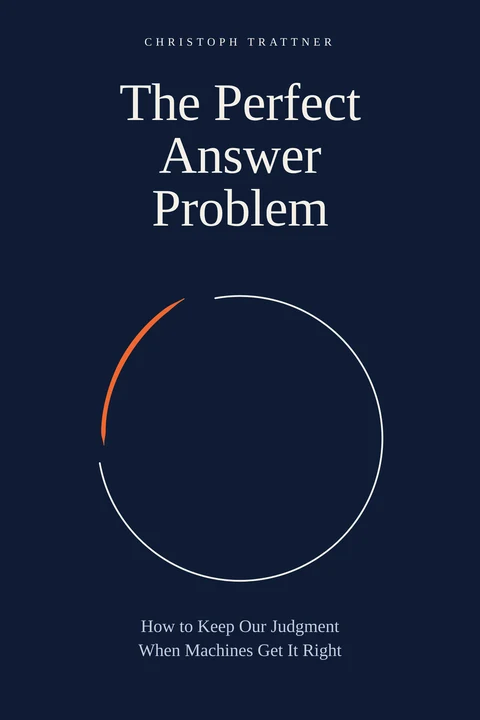
The drill puts into practice the question of my book in progress, The Perfect Answer Problem: How to Keep Our Judgment When Machines Get It Right.
Ask for a plan
Say which course or department would play and roughly how many students. I answer by email.
Nice Try is free while it is new: nothing is charged and nothing is sold. It is made by Christoph Trattner and runs on this website. All plans side by side
Teaching at a school instead? Nice Try for schools. Running a newsroom? Nice Try for newsrooms.
Got a code from your lecturer?
Open your course’s drill room in the game.